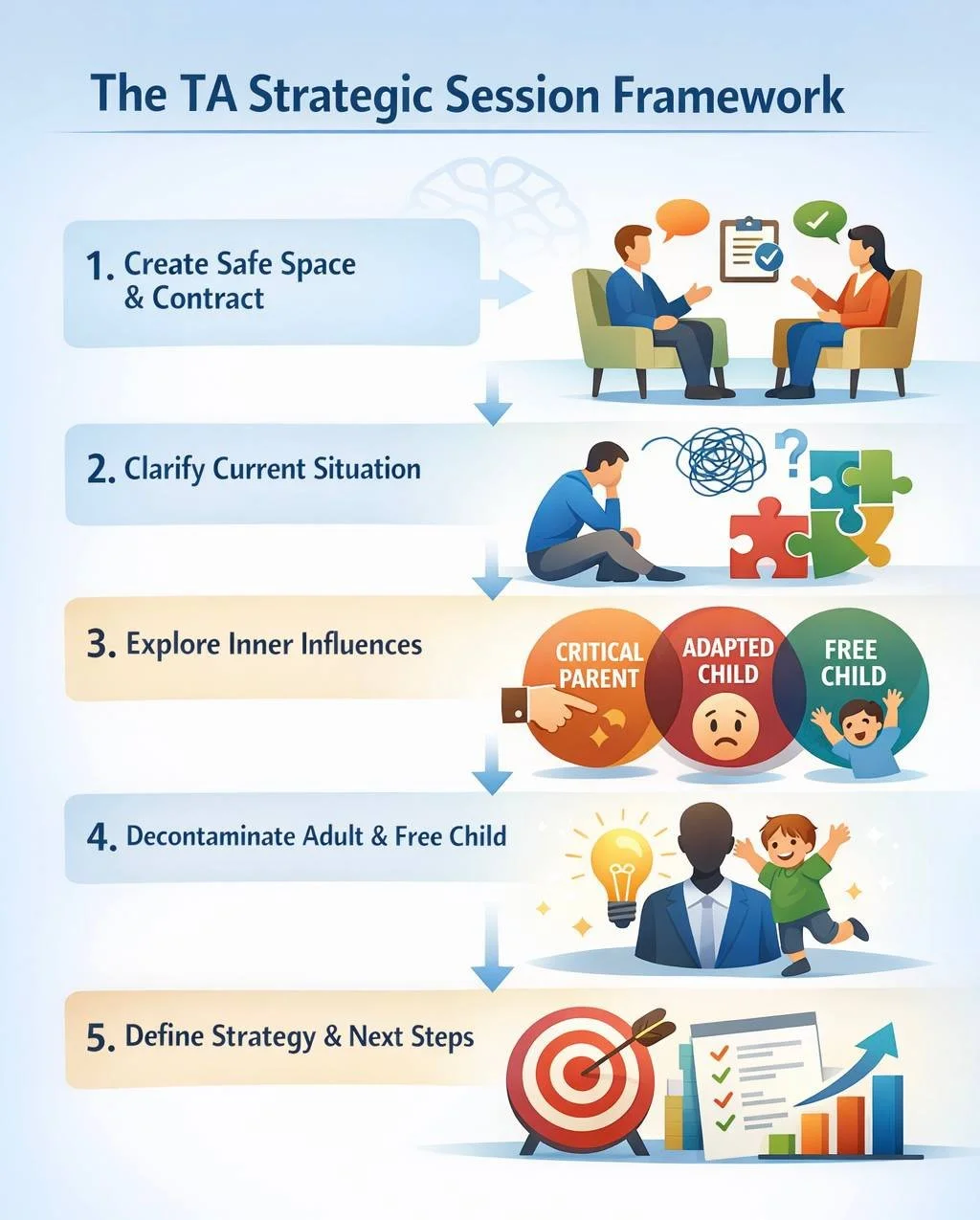
Why Clients Often Arrive in a “Confused State”
In many cases, when a client comes to a strategic consultation, their psychological state is not fully centered in the Adult ego state.
Instead, part of their thinking may be influenced by the Child ego state.
This does not mean something is wrong. In fact, it is natural.
The Child contains our desires, creativity, emotional energy, and impulses. Very often, genuine aspirations come from the Free Child — the part of us that wants to explore, create, build, and experience life.
However, goals can also come from another part of the Child: the Adapted Child.
When goals originate from the Adapted Child, they are often influenced by:
• family expectations
• cultural norms
• internalized rules about success
• pressure to meet external standards
• fear of disappointing others
In these cases, a person may say they want something — a career change, a business, a promotion, a specific lifestyle — but internally something does not move forward.
This is where symptoms often appear:
• procrastination
• lack of motivation
• confusion about priorities
• repeated stops in progress
• a feeling of being stuck
From the outside it may look like the client “lacks discipline”.
From a TA perspective, however, something deeper is happening.
There may be internal conflict between ego states.
The First Task of the Strategic Session: Clarification
The first stage of the session is what we could call psychological clarification.
The consultant and the client together explore questions such as:
• Where are you now in your professional or personal situation?
• What exactly feels unclear or stuck?
• What do you think you want?
• What makes it difficult to move toward it?
At this stage, the goal is not yet to create a strategy.
The goal is awareness.
Often the client begins to see that their goals may come from different internal voices.
For example:
Client:
“I want to start my own business, but every time I begin planning, I stop.”
When we explore further, we may discover:
• a Free Child that wants independence and creativity
• a Critical Parent saying “This is risky and irresponsible”
• an Adapted Child trying to avoid making mistakes
These internal dynamics can create confusion and paralysis.
Working With Contamination in the Adult
In Transactional Analysis, we sometimes talk about contamination of the Adult ego state.
This happens when the Adult — the part responsible for realistic thinking and decision-making — is mixed with beliefs or fears coming from the Parent or Child.
For example, a client may believe:
• “If I change careers, I will disappoint my family.”
• “Successful people must always work extremely hard.”
• “If I fail once, it means I’m not capable.”
These beliefs often sound like objective reality to the client. However, they may actually originate from internalized parental messages.
During the session, the consultant helps the client examine these beliefs:
• Where did this idea come from?
• Is it objectively true today?
• Is it helping or limiting you?
This process gradually decontaminates the Adult, allowing the client to see the situation more clearly.
Exploring the Inner Parent
Another important part of the strategic session is identifying internal parental voices.
The Critical Parent may say things like:
• “You should already know what to do.”
• “You must not fail.”
• “That is unrealistic.”
These messages often create pressure or fear.
When these voices remain unexamined, the client may unknowingly organize their life around them.
Bringing these messages into awareness allows the client to begin separating inherited expectations from authentic desires.
Reconnecting With the Free Child
Once the internal pressures become clearer, space opens for another important question:
What does the Free Child actually want?
The Free Child is connected to:
• curiosity
• creativity
• genuine interest
• vitality
• intrinsic motivation
Many strategic breakthroughs happen when clients reconnect with this part of themselves. Instead of pursuing goals that feel heavy or obligatory, they begin identifying goals that feel energizing and meaningful.
Returning to the Adult: The Moment Strategy Becomes Possible
Only after this clarification process does the strategic conversation truly begin.
Now the client is more likely operating from a decontaminated Adult, supported by the energy of the Free Child rather than the pressure of the Adapted Child or the Critical Parent.
From this position, the client can realistically evaluate:
• current resources
• constraints
• opportunities
• next steps
At this stage, strategy becomes much clearer.
Instead of forcing decisions, the client can ask:
• What direction makes sense for me now?
• What is the first realistic step?
• What resources do I already have?
• What support might I need?
Sometimes this process leads to a longer coaching journey. But interestingly, in many cases one well-facilitated strategic session is enough. Once the client reconnects with their Adult and Free Child, they regain the ability to move forward independently.
The True Value of the First Strategic Session
The real value of the first strategic session is not simply creating a plan.
It is helping the client move from confusion to clarity.
From the perspective of Transactional Analysis, the session supports the client in:
• recognizing internal dynamics between ego states
• separating inherited expectations from authentic goals
• freeing the Adult from contamination
• reconnecting with the energy of the Free Child
When this shift happens, strategy becomes much more than a plan.
It becomes a conscious choice.
And from that place, meaningful action becomes possible.
Ready to experience your own strategic session?
Whether you are:
• A client who wants clarity about life direction, career, or important decisions
or
• A coach, consultant, or therapist who wants to learn how to structure powerful strategic sessions —you can experience this process in practice.
Strategic Session with Viktoriia Kotova
In one focused session, we explore your current situation, clarify what truly drives your decisions, and define your next strategic steps.
With 20+ years of experience as a psychologist, coach, HR generalist, and business strategist, Viktoriia Kotova helps people move from confusion to clarity and create a direction that truly works for them.
When a person comes to a strategic session with a coach or consultant, something important has usually happened internally.
They have reached a point where they cannot fully determine their direction alone. They may feel confused, stuck, or pulled in several directions at once. Sometimes they have goals but lack energy to pursue them. Sometimes they are unsure whether the goals they have are truly theirs.
The role of the coach or consultant in the first strategic session is not immediately to build a strategy.
The first task is something more fundamental: to clarify the client’s starting point.
Before we decide where to go, we must understand where we actually are.
Transactional Analysis (TA) provides a powerful framework for this process.